Published · Updated · Alper Yazagan · 8 min read
Reverse Osmosis Technology: How It Works and Where It Is Used
Learn how reverse osmosis works, what RO membranes remove, and how pretreatment, recovery, energy use and monitoring shape industrial desalination performance.
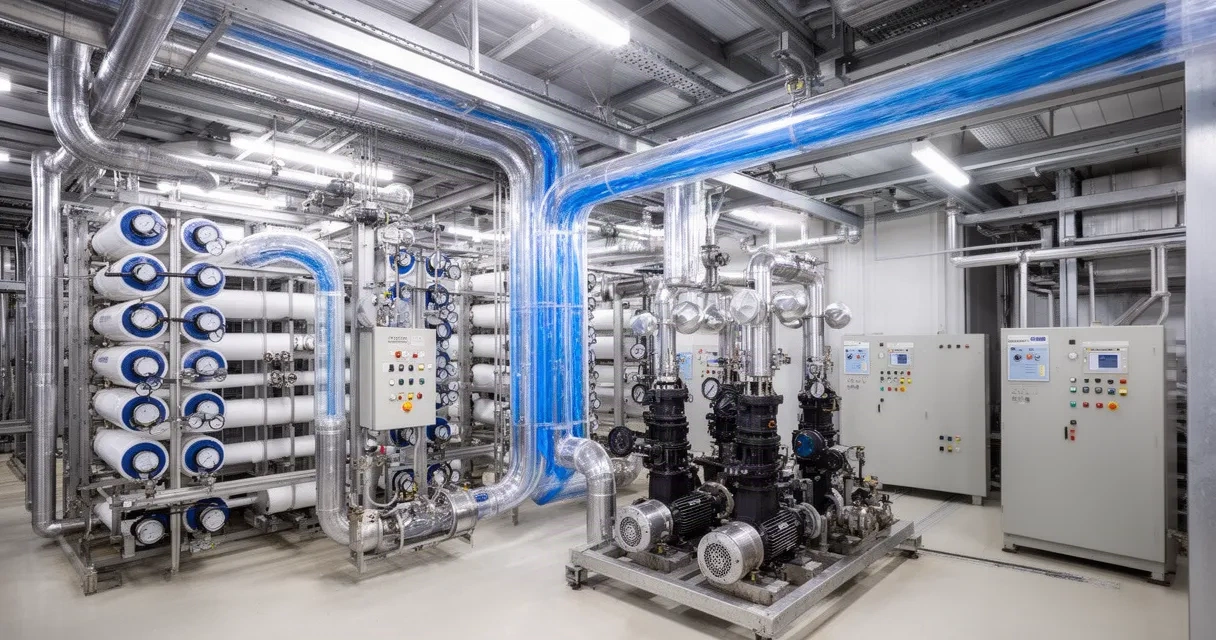
Reverse osmosis (RO) is a pressure-driven membrane process that separates water from much of its dissolved salt content. It supports seawater desalination, brackish-water treatment, wastewater reuse and industrial process-water production.
This guide explains the process, membrane construction and operating measures that matter to industrial plant managers and engineers.
Osmosis vs. Reverse Osmosis
In natural osmosis, water moves through a semipermeable membrane from the less concentrated solution toward the more concentrated solution, when no opposing pressure prevents that movement. In RO, applied hydraulic pressure reverses the direction of net water transport.
The driving force is not feed pressure alone: permeate backpressure and the osmotic pressure difference also matter. More saline feedwater generally requires greater pressure to produce a comparable water flux. DuPont explains this relationship in its RO operating principles.
RO does not produce universally “pure” water. Removal varies by substance, membrane and operating conditions. The EPA’s treatment overview describes RO as useful for removing dissolved salts and many other contaminants, with pretreatment and concentrate management as important requirements.
How an Industrial RO System Works
1. Analyze and Pretreat the Feedwater
Design starts with water analysis, including salinity, individual ions, pH, temperature, suspended solids and biological or organic contamination. Depending on the source, pretreatment may involve clarification, media filtration, ultrafiltration, cartridge filtration, softening or chemical dosing.
Antiscalant selection and pH adjustment require a scaling assessment at the proposed recovery. Polyamide membranes also need protection from incompatible oxidants, including free chlorine. A cartridge filter alone does not control dissolved salts or every fouling mechanism.
2. Pressurize the Water
A high-pressure pump supplies the driving force for separation. Required pressure depends on salinity, temperature, membrane permeability, target production, recovery and hydraulic losses. Seawater RO generally operates at higher pressure than brackish-water RO; there is no single pressure setting suitable for all installations.
3. Separate Permeate and Concentrate
Conventional spiral-wound RO uses crossflow: feedwater travels along the membrane surface while part of the water passes through it. The remaining stream carries rejected salts toward the concentrate outlet. Crossflow helps limit accumulation near the surface but does not eliminate fouling or scaling. See DuPont’s RO technology explanation.
4. Condition the Product and Manage the Concentrate
Permeate treatment depends on its intended use. Drinking-water production may require remineralization, pH stabilization and disinfection; high-purity industrial uses may need another RO pass or polishing. Concentrate requires a site-specific management route that accounts for salinity, contaminants and environmental requirements. The EPA identifies concentrate disposal and post-treatment corrosion control as design considerations.
RO Membranes and System Configurations
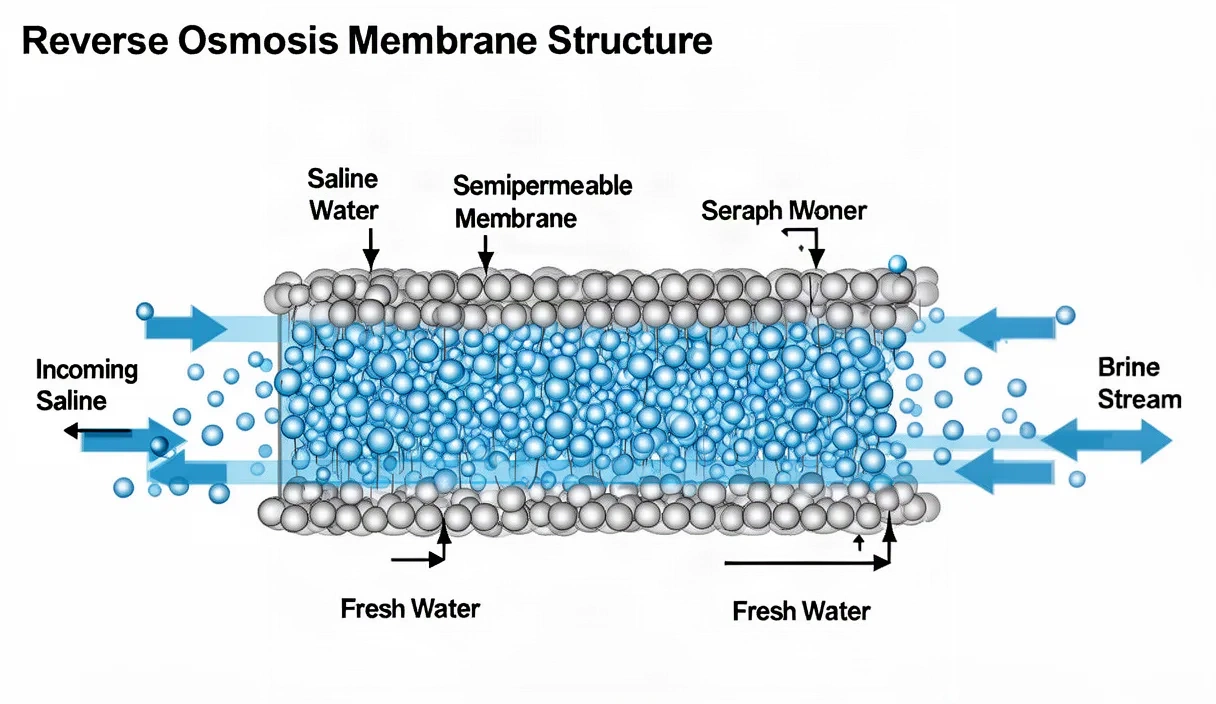
Common thin-film composite RO membranes have a selective polyamide layer, a microporous polysulfone support layer and a polyester backing. The active layer should not be described as a simple screen with a universal pore-size cutoff. Its transport and selectivity differ from ordinary particle filtration. See DuPont’s membrane construction description.
In spiral-wound elements, membrane sheets and spacers surround a permeate collection tube. Multiple elements fit inside pressure vessels.
Two configuration terms are particularly important:
- Multiple stages: concentrate from one stage feeds another, allowing more water to be recovered within a pass.
- Multiple passes: permeate from one pass feeds the next, providing further treatment of the product water.
Adding a stage and adding a pass are therefore different design decisions. DuPont details double-pass arrangements.
Industrial Reverse Osmosis Applications
| Application | Main purpose | Key design consideration |
|---|---|---|
| Seawater reverse osmosis (SWRO) | Produce freshwater from seawater | High osmotic pressure, intake quality and energy recovery |
| Brackish-water reverse osmosis (BWRO) | Reduce salts in groundwater or other moderately saline supplies | Site-specific scaling chemistry and concentrate management |
| Wastewater reuse | Reduce dissolved constituents after upstream treatment | Organic fouling, biological control and variable feed quality |
| Industrial process water | Supply water for boilers, manufacturing and other processes | Product specifications and any additional polishing required |
Each application needs its own treatment design. A recovery target or pretreatment train that works for one source may be unsuitable for another.
Key RO Performance Metrics
Recovery measures how much feedwater becomes permeate:
Recovery (%) = permeate flow ÷ feedwater flow × 100
For example, 100 m³/h of feed producing 75 m³/h of permeate gives 75% recovery and 25 m³/h of concentrate, assuming no other flows. This is an arithmetic example, not a recommended operating target.
Higher recovery reduces concentrate volume but increases its dissolved-solids concentration. The acceptable limit depends on scaling risk, membrane flux, minimum concentrate flow, pressure limits and product quality.
Observed salt rejection compares feed and permeate concentrations:
Salt rejection (%) = (1 − permeate salt concentration ÷ feed salt concentration) × 100
Use comparable measurements for the same constituent or salt basis. Rejection is not the same as recovery, and a membrane’s laboratory rating is not a guarantee for every contaminant in an operating plant.
Permeate flux is permeate flow divided by active membrane area, commonly expressed in L/m²/h. Stage pressure drop is the feed-to-concentrate pressure loss through that stage; it is distinct from the pressure difference across the membrane.
Track these values alongside temperature and conductivity. For interpreting changing conditions, see our reverse osmosis optimization guide.
Energy Use and Operating Costs
RO energy demand reflects salinity, production rate, recovery, membrane condition and pump efficiency. The U.S. Department of Energy’s desalination overview explains why saltier water requires greater pressure. Compare plants using specific energy consumption (SEC) in kWh per m³ of product water, stating whether the measurement covers only the RO train or the whole facility.
Useful efficiency measures include:
- Recovering hydraulic energy from pressurized concentrate where technically and economically suitable.
- Matching pumps and variable-frequency drives to the required operating range.
- Maintaining pretreatment and cleaning before deposits create excessive resistance.
- Evaluating recovery and flux together against water-quality and equipment limits.
Energy recovery is not a universal percentage saving. Evaluate equipment and operating strategy for the specific application.
Assess total cost per cubic meter, including electricity, chemicals, membrane replacement, labor, downtime and concentrate handling. Increasing recovery alone does not guarantee the lowest cost.
Monitoring, Fouling and Membrane Maintenance

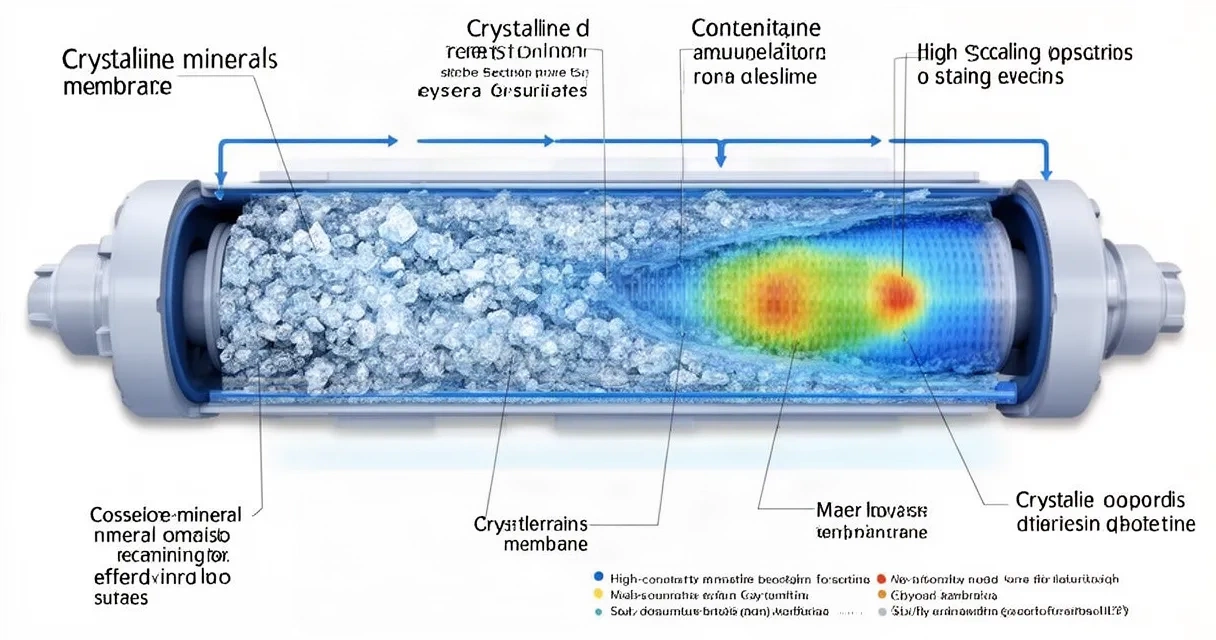
Fouling includes particulate deposits, organic accumulation and biofilm growth. Scaling is inorganic fouling caused by precipitation of sparingly soluble constituents; some deposits, including silica, can be amorphous rather than crystalline.
Prevention combines source-appropriate pretreatment, validated recovery and compatible chemical dosing. Antiscalants do not replace biological control or remove established deposits. Our RO membrane scaling precautions explain the chemistry and prevention options.
Record feed, permeate and concentrate flows; stage pressures; conductivity; pH; temperature; dosing; and energy use. Compare normalized performance with a stable baseline so seasonal temperature or salinity changes are not mistaken for membrane deterioration.
Investigate rising pressure drop, declining normalized production or increased salt passage. Select cleaning chemistry for the identified foulant and follow membrane-specific limits; routine acid washing is not a universal remedy. Check instruments, seals and operating conditions before concluding that membranes need replacement.
SCADA dashboards and analytics can support trend review and alarms. Any automated adjustment should remain within validated process limits, and savings should be demonstrated from measured plant data.
Frequently Asked Questions
Does Reverse Osmosis Remove All Contaminants?
No. RO rejects many dissolved salts and contaminants, but removal is substance- and condition-dependent. Confirm performance against the intended water-quality specification rather than assuming permeate is sterile or chemically pure.
What Recovery Should an RO Plant Use?
There is no universal optimum. Select recovery using feedwater chemistry, membrane projections, scaling assessment and equipment constraints. Validate the target across expected seasonal conditions.
How Long Do RO Membranes Last?
Service life depends on feed quality, pretreatment, chemical exposure and operating history. Replacement should follow performance and economic assessment, not a guaranteed calendar interval. See our RO membrane replacement guide.
Does an Antiscalant Remove Salt?
No. Antiscalants inhibit certain precipitation and deposition processes within their application limits. Dissolved salts still need to leave the RO system in the concentrate stream.
How Can Operators Improve RO Efficiency?
Start with reliable measurements, normalized performance trends and a verified water analysis. Then assess pretreatment, pump operation, recovery, cleaning and energy recovery together. Avoid changing several setpoints without checking their combined effect.
Put RO Operating Data to Work
Reliable reverse osmosis performance depends on matching membrane technology to feedwater chemistry and keeping operation within the validated design. Contact Clewas to discuss monitoring and optimization opportunities for your plant.